
Category: Human Resources & Organizational Development

Building the Best Workforce and Business Leaders
Building the Best Workforce and Business Leaders

Building the Best Workforce and Business Leaders
Pursuing your online bachelor’s in organizational leadership (BSOLL) from University of Louisville is a strong first step to grow as a leader. As you look toward applying your knowledge to the workplace, don’t be taken by surprise. For many new business leaders, the workplace of tomorrow will look a little different.

Gone are the days of business suits, dedicated desks and rigid standards. Even brick-and-mortar offices are on the outs. Iconic companies like Google are pioneering a fresh approach to attract a new talent pool — Millennials and Gen Z.

Consider the signs of change you’re probably already seeing:

  • A young workforce. Millennials grew to become the majority of the national workforce in 2015, and Gen Z workers are close behind. That means major change is on the way. Your leadership tactics must anticipate change.
  • Shifting works styles and expectations. New workers have a greater desire to influence their work environment, often by defying corporate structure or defining work standards that embrace a more relaxed approach. Frankly, many younger workers have no patience for “the way it’s always been done.”
  • Early tech adoption. New tech tools are infiltrating the office, and not just in the IT department. You may already be using tech-based workflow solutions such as Slack and Trello. This will only continue.
  • New ways of thinking. Office culture is changing. Emphasis is shifting toward more transparency, more mobility and worker input in daily operations. Flexible hours, 360-degree training and the creation of mentors (not managers) are just a few examples.

The organizational leadership and learning curriculum crafted by UofL faculty anticipates these shifting workplace dynamics. Courses are developed around ways the business world is changing — the ways you’ll realistically apply the knowledge you gain through your online degree. Here are a few course highlights that emphasize proactive leadership in the workforce:

  • ELFH 300 Prior Learning Assessment (Portfolio Class)
    First of all, take credit for the experience you have already gained on the job. Based on your professional experience, you can earn up to 48 credits tuition free!
  • ELFH 412 Coaching and Talent Management
    Understand the knowledge, skills and dispositions for new leaders in talent management, career development and coaching. You’ll learn the best ways to maximize team performance and reach key goals for each individual and the organization overall.
  • ELFH 414 Diversity
    Explore the challenges and rewards of differences within your workplaces. You’ll focus on the application of cultural competence and diversity solutions within a changing office environment.
  • ELFH 420 Negotiation and Conflict Management
    Understand the nature of conflict (types, sources and processes) with special emphasis on organizational conflict and how it’s evolving. You’ll gain skills in negotiation, mediation and alternative dispute resolution options.
  • ELFH 442 Supporting Organizational Change
    Anticipate the course of change! You’ll discuss causes of change in your organization and the professional and personal competencies you can bring to the table to support healthy change.

Enroll at University of Louisville Today

Put your experience to work and start down the path to becoming a great business leader. Learn more about UofL’s online bachelor’s in organizational leadership and learning.

About UofL Online Learning

The University of Louisville currently offers online programs in various areas of study for adult learners who are not able to come to a physical campus, but want to earn a college degree or certificate and advance their career.

The University of Louisville is a nationally-recognized, metropolitan research university, with a commitment to the liberal arts and sciences, as well as the intellectual, cultural, and economic development of our diverse community of learners.
CFDC Program at UofL Featured on U.S. Army Website

CFDC Program at UofL Featured on U.S. Army Website

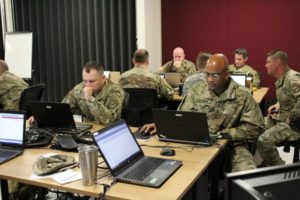
U.S. Army Cadet Command has recently partnered with the University of Louisville to design and implement the first Cadre & Faculty Development Course at Fort Knox, Kentucky. Through this program, graduate students earn 12 master’s level credit hours for the residence phase and an additional 12 credits for the clinicals at their respective campuses. Undergraduate students earn 15 credit hours for the residence portion and 12 credits for clinicals.

cfdc-rotc-courseThe U.S. Army website features the University of Louisville – Department of Educational Leadership, Evaluation and Organizational Development through an article about the Cadre Faculty Development Course (CFDC) at Fort Knox. The article discusses details about curriculum and outcomes of the program. The fall 2016 issue of the UofL Magazine also featured the program and other options the University offers for military service personnel.

Active duty military have a wide array of educational choices throught UofL Online and benefit from a Tuition Assistance (TA) rate of $250 per credit hours for most of the programs. Professional degrees (i.e., Master of Engineering in Engineering Management) also offer a special tuition rate.

UofL Online programs include bachelor’s, master’s, graduate certificates and teaching endorsements. View all online offerings and select a program that best fits your background, professional goals and interest.

Rethinking Organizational Challenges

Rethinking Organizational Challenges

How One Course in the MSHROD Online Program Delivers Surprises—and Results

“This course surprises people.” That’s how Dr. Denise Cumberland sums up Organizational Analysis, one of several required courses in the Master of Science in Human Resource and Organizational Development (MSHROD) online program at UofL. Officially coded ELFH 662, the course sets the groundwork for much of the content the program offers professionals who are advancing their careers and expanding their HR expertise.

“It’s about rethinking how to approach organizational challenges,” says Dr. Cumberland. “The course title is very broad, but the core objective is to help students uncover what’s going on below the surface when problems or opportunities occur in their organization.” These issues can range from low employee morale, loss of productivity, lagging customer satisfaction scores, declines in membership, to whether a firm should incorporate some new service element or new product. “We business people tend to be very solutions-oriented,” Dr. Cumberland continues, “we want an immediate solution—a silver bullet. This class shows students that you have to take a step back and understand that what you see on the surface is the symptom, not the cause.”  She adds, “This entire class is about going deeper than our first assumption about why a problem exists.”

What surprises students is the value of stepping back and asking questions to discover the underlying root cause of the issue. To illustrate this point, Dr. Cumberland uses a restaurant analogy. If patrons are scoring the restaurant badly or posting poor reviews, management might immediately assume that the team member is to blame. A costly training program might be implemented. But the real issue could be much broader: long waits, operational challenges, the temperature of the dining room. Instead of “our staff should smile more”— a simple, reactionary response — managers need to consider the broader picture. It may be the pace of the work, a lack of incentives or simply understaffing certain times and sections. To uncover the true cause of customer dissatisfaction, empirical data must be gathered. It must be processed and reviewed. And it must inform recommendations that underscore the real challenges and broader issues at play. “Before you apply a costly intervention, you need to consider all angles.”

This course, though, is not just about hypotheticals. As part of the course content, students look at their own organizations … the places they work, the churches they attend, the volunteer organizations they support. They tackle issues ranging from turnover to customer complaints to ineffective fundraising efforts. Most importantly, they look past the “blame game” and put together a solid assessment of what’s really happening: what’s causing the problem, or where an opportunity may lie. And best of all, students get to see the results of their work by applying it to the organization they’ve chosen to analyze.

As one of Dr. Cumberland’s students, Kristi Jones, commented, “I don’t think the effect of this class would have been the same if we were only taught the concepts in class. That’s what I really enjoy and value about the MS HROD program as well. It was great to see that what I was learning in class would make a real difference in my organization.” Another ELFH 662 student phrased it this way “My biggest take-away was learning how to analyze a situation and how to identify the gap between “what is” and “what should be.” Dr. Cumberland says “my joy is hearing students discover the underlying issue and I’m especially grateful when students come back and tell me that they were actually able to fix the problem because the data that they had gathered and analyzed provided the organization with reliable information upon which to develop more focused solutions.”

As each student’s individual analysis unfolds, the online format facilitates group work and peer review. Students are arranged in “pods” of four to five people. They trade ideas about their issues or opportunities. They gather advice from each other—fellow students help make sure a student is not making an assumption. Fellow students support one another by reviewing the investigative tools each student develops and they help each other to address the issue from multiple angles. It’s a peer support network that works well.

“Ours is a very unique online class,” concludes Dr. Cumberland. “Think of it as a webinar. We meet once a week for 90 minutes. During that time I can create smaller groups where students can talk to peers. We explore topics and review the readings. Everyone has access to me and to each other. It is an active world where students are connecting with their peers while learning on a very personal level. And the results are always rewarding.”

The MSHROD program attracts a broad spectrum of professionals, representing almost every capacity under the human resources umbrella. Many people are involved in training, hiring or talent management, while others come from marketing or operations. It’s a diverse group, but one assumption generally connects them as they walk in the door: the myth of the immediate fix. “It’s always more systemic than they realize.”

Learn more about UofL’s MSHROD program—and courses like Organizational Analysis—by clicking here.

US News & World Report – Online Programs Rankings 2016

US News & World Report – Online Programs Rankings 2016

The value and quality of online programs offered at the University of Louisville has been recognized again by the U.S. News and World Report’s 2016 Rankings of the United States’ best colleges and universities, released in January.

More than 1,200 online programs offered at regionally accredited institutions were evaluated. Out of those, UofL online programs were ranked as the nation’s best across three categories: Criminal Justice, Computer Information Technology, and Education.

The Online Graduate Criminal Justice (CJ) Program within the College of Arts and Sciences at UofL rank #9 for 2016, which is an improvement over the #13 ranking last year. The master’s in criminal justice online program gets highest scores in faculty credentials and training, student services and technology, and student engagement.UofL-GrawmeyerHall-crop

The Online Graduate Computer Information Technology (CIT) Programs offered by the J.B. Speed School of Engineering at UofL rank #23 for 2016, sharing this position with University of North Carolina-Greensboro. The online computer science programs score highest in faculty credentials and training, and in admissions selectivity.

The Graduate Education Programs offered through the College of Education and Human Development at UofL rank #124 for 2016, tied with Brandman University, Northwestern State University of Louisiana, St. Leo University, University of North Texas and Virginia Commonwealth University. The online education programs score high in faculty credentials and training, and student services and technology. The range of education online programs include a master’s in higher education administration, a master’s in special education, and a master’s in human resources and organization development.

The US News & World Report 2016 rankings are based on a survey of academics at peer institutions and each school’s score reflects its average rating on a scale from 1 (marginal) to 5 (outstanding). In 2015, the University of Louisville, overall as an institution, was ranked #168 among all national universities, #91 of top public schools and #134 among best colleges for veterans. Updated institutional rankings for 2016 are expected later this year.

Visit UofL Online Learning to learn more about our online degree, certificate and endorsement programs.

xxx

Contact Laura Dorman, marketing manager – online programs: laura.dorman@louisville.edu; 502.852.0363.