Category: Feature Stories

Read UofL Online feature stories highlighting university achievements, faculty excellence, and the dedication of military students and partners in online learning.

Filling the Empty Frame: Virginia Braden and the “Perfect Fit” of Online Education

Filling the Empty Frame: Virginia Braden and the “Perfect Fit” of Online Education

Virginia Braden
Virginia Braden

Selecting the perfect degree program is an age-old rite of passage for students. Historically, 18-19-year-olds would go straight from high school through college before taking on careers and starting families. Students today often detour from that traditional path and blaze their own trails back to the classroom, sometimes later in life, and usually with diverse sets of needs, concerns, and expectations. Cutting edge online degree programs provide the perfect blend of fit and flexibility for the frenetic pace of today’s modern students. For University of Louisville Criminal Justice graduate and non-traditional student, Virginia Braden, online learning was not just simply the right fit for her busy lifestyle; it was the perfect fit.

Virginia Braden completed both her bachelor’s and master’s degrees in Justice Administration (now called Criminal Justice) at the University of Louisville, and credits the flexibility of online learning for allowing her to accomplish her long-held dream of collegiate success. Though local to the region, the divorced working mother of five children said that traveling to campus each day was, “simply not an option,” given the demands of her personal and professional life.

“The online degree program at UofL made it possible for me to capture a dream that otherwise would have remained forever out of reach,” Braden said. “Most important to me, is that it has communicated to my children the worth and value of a higher education – and that if you are willing to work for what you want, anything is possible.”

Though she’s gone on to complete a graduate degree and is a licensed private investigator and behavioral profiler, one memory still stands out from Braden’s time at UofL.

“The night I graduated with my bachelor’s degree all five of my children were present and as I went on to pursue my master’s degree online with UofL as well, they’ve been my biggest supporters,” she said. “Two of them are now college age and are themselves pursuing degrees.”

Braden said it was UofL’s reputation for educational excellence that first piqued her interest, but credited the quality of the instruction in the online Criminal Justice program for keeping her desire for continued education strong, while obtaining not only one, but two degrees via e-learning.

“The faculty at the University of Louisville are so completely dedicated to the success of their students,” she said. “They are remarkable in their personal attention to the students and though I had all online classes, I was able to develop and maintain relationships with them that have served me so well throughout the years – all without ever stepping foot in a brick and mortar classroom.”

“There is a real sense of community in the online classes and the professors are intentional in their commitment to forging and nurturing that sense of community,” she added.

Braden said that the strong sense of community was especially important as she and her children went through a traumatic divorce and spent time living in a hotel. During this time, Braden’s drive and determination to meet her dream and attain her degree pulled her through.

“Without question, the drive to complete my degree, the ability to continue on towards that goal via online classes in the midst of such a dark time provided me an anchor,” she said.

For Braden, success was not just an option, it was a requirement.

“I remember I had an empty frame hanging on my wall in my home office, a reminder of the goal I was after, and a promise to myself that I would one day have a degree to put in it,” she said. “When we became homeless for that period of time, I packed up the empty frame and brought it with me to the hotel and put it out, determined that though my life circumstances had changed, my goals and vision had not.”

Now Braden’s frame has been filled and although she encountered personal hardships during her journey as a student, she persevered, and ultimately found e-learning to be the best option for achieving her lifelong educational goals. Not only did Braden fill her original empty frame, she also filled a second one by earning her master’s degree online as well. Now her framed diplomas proudly serve as a reminder of the goals and dreams she achieved through online learning at the University of Louisville.

Visit our Criminal Justice online program page to learn more about the courses offered, and to find a program that is the perfect fit for you.
Classroom Reading Endorsement (P-12) now offered 100% online!

Classroom Reading Endorsement (P-12) now offered 100% online!

The University of Louisville and the College of Education and Human Development are excited to announce the addition of the Classroom Reading Endorsement (P-12) to their repertoire of online programs. This endorsement prepares teachers to become the literacy leaders of today and tomorrow and create dynamic learning environments that are both intellectually challenging and empowering for students with varied abilities.

The inquiry-centric and research-driven curriculum makes this program unique as it engages teachers to connect pedagogic approaches and concepts with real-world classroom settings to maximize students’ potential.

The online CRE (P-12) program is designed to develop and support teachers as researchers in their own classroom where they can uncover how to effectively help every student in finding his or her own unique pathway to literacy. Educators with a CRE (P-12) can gain increased marketability and advancement within the field. Additionally, completion of this program brings opportunity for leadership roles, career focus transitioning, and increased salaries. Endorsement students have the opportunity to grow professionally while expanding their credentials to excel in the creation and implementation of cutting edge P-12 literacy based learning methods.

The CRE (P-12) curriculum is aligned with the standards and requirements of the International Literacy Association (ILA) and the National Council of Teachers of English (NCTE).

Speaking to the tremendous value of this program, for both teachers and students, Lori Norton-Meier, Ph.D., Literacy Program Coordinator at UofL, said: “The word ‘inquiry’ is central to our mission and program design. We don’t just lecture on best practices – we create opportunities for teachers to be inquirers in their own classrooms – that’s what makes us different from other programs which are more prescribed and rigid.  We build on teachers’ expertise and empower teachers to be researchers in their own classroom.  It is the only way we are going to make a real difference for every reader and writer in our classrooms!  We have to keep questioning, keep wondering and keep studying our practice. We believe that the teaching and learning are found in each teacher’s classroom – that is why we are so excited about this online program – it moves the learning out of a university classroom and into realistic settings.

The Classroom Reading Endorsement (P-12) 18 credit hours program is now being offered in a 100% online format, providing great ease and flexibility in accommodating the schedules of current teaching professionals. Utilizing a proven applied-knowledge method to enhance various personal learning styles, students will have the freedom to access their course content from any location, while selecting a predetermined time of day for their online sessions.

To be considered for admission, CRE (P-12) online program applicants must hold a bachelor’s degree as well as a valid initial teacher certification. The endorsement can be completed as a standalone online program, or in conjunction with the University of Louisville’s Master of Education in Teacher Leadership or Master of Education in Literacy, as well as a Rank I program.

The University of Louisville continues its commitment to advance the knowledge of educators through endorsement and extension programs. The online P-12 Classroom Reading Endorsement program is another great example of such program that allows them to truly stand out in their profession and lead the efforts of improving literacy in their classroom, community and the nation.

Please contact us with any questions – our online learning counselors are happy to answers your questions and connect you with the resources you need to apply and enroll at UofL.

Accreditation: National vs Regional Comparison

Accreditation: National vs Regional Comparison

The information in this article is out-of-date as of July 2020.

Let’s look at the difference between national vs. regional accreditation.

There are two primary types of accreditation: national accreditation and regional accreditation. National accreditation may sound more prestigious, but in reality this is not the case. In fact, the difference between a regionally accredited and nationally accredited school has less to do with the quality of the education and more to do with the recognition and type of education you receive.

Here is a brief side-by-side comparison of the two types of accreditation:

Regional Accreditation National Accreditation
More liberal arts courses required, leading to a more well-rounded education Fewer liberal arts courses required for a more specialized education
Generally viewed as more prestigious and reputable in both academia and corporate America Not regarded as highly by the academic and corporate worlds
Transfer credits widely accepted by other institutions and professional licensing bodies Transfer credits not typically accepted by other institutions and professional lincensing bodies
Higher admissions standards; more selective acceptance Less competitive; easier to get in
Typically more expensive Typically cheaper
Prime candidates for corporate tuition reimbursement programs Often excluded from corporate tuition reimbursement programs
Offers almost exclusively professor-led courses More likely to have self-study courses

Regionally accredited schools are typically traditional colleges and universities with one or more physical campuses, while nationally accredited schools are generally vocational, trade, or religious institutions of higher learning.

Regional Accreditation

Regional accreditation traces its roots to 1885 and its importance has grown exponentially, now leading the development of higher education in the U.S. and protecting the integrity of the learning process and outcomes, and the interest of students in a diversity-driven higher education environment (cihe.neasc.org).

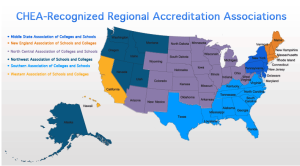
There are six regional accreditation bodies in the United States: Southern Association of Colleges and Schools (SACS), Western Association of Schools and Colleges (WASC), Northwest Association of Schools and Colleges (NASC), North Central Association of Colleges and Schools (NCACS), New England Association of Schools and Colleges (NEASC), and Middle State Association of Colleges and Schools (MSACS) (Bray, 2013).

The University of Louisville is accredited by the Commission on Colleges of the Southern Association of Colleges and Schools to award associate, bachelor, master, specialist, doctoral, and first-professional degrees (D.M.D., J.D., M.D.). See online programs available at UofL.

You can see in the image below which accrediting body recognized by the Council for Higher Education Accreditation (CHEA.org) accredits which region and its specific states.(elearners.com)regional accrediting bodies map

While each of the six regional accreditation bodies has its own set of rules and standards for granting accreditation, the requirements are largely similar if not identical. The standards imposed by regional accreditation bodies often revolve around the central rule of having a mission and purpose that is appropriate for higher learning. All other guidelines, such as having a planning and evaluation process for improvement, obtaining and retaining skilled faculty, having physical resources like a library and technological equipment, and having sufficient financial resources, are in place to ensure that the institution will be able to provide its students with a quality education (NEASC, 2011) (SACSCOC, 2012).

Because of the high standards set by regional accreditation bodies, the academic world and the corporate world largely consider regionally accredited schools to be the premiere institutions of higher learning. This means that a regionally accredited school is generally more prestigious and reputable and more competitive with higher admission standards than a nationally accredited school (Phillips).

One of the most important differences between regionally and nationally accredited schools is the ability to transfer credits from different schools. Because all regionally accredited schools are held to very similar standards, they know that students who have attended a different school which is regionally accredited have received a quality education. This is why regionally accredited schools will generally accept credits transferred from another regionally accredited school and put it towards the transferring student’s degree. (Phillips).

Most regionally accredited colleges’ curricula call for more liberal arts courses to fulfill graduation requirements, thus providing a wide range of knowledge and better preparation for various career paths and life-long learning. Whether delivered on campus or online, nearly all courses at a regionally accredited institution are led by instructors, adjuncts or tenured professors. Very few self-study courses are offered (Phillips).

National Accreditation

Nationally accredited institutions generally focus on providing specific instruction for a specialized career and place more emphasis on practical courses rather than a well-rounded curriculum (Phillips). Although nationally accredited schools are often cheaper than regionally accredited schools, they are sometimes excluded from corporate tuition reimbursement programs, unlike regionally accredited schools (Phillips).

Another issue to consider is whether a degree from a nationally accredited institution will be accepted by professional licensing bodies or other higher learning institutions. Many careers require licensing after earning a degree. Students who graduate from nationally accredited schools are often not accepted to take licensing exams (Howell). As mentioned, courses from nationally accredited schools are typically not accepted for transfer credit to other institutions; additionally, in many cases a regionally accredited school will not recognize a degree from a nationally accredited school, preventing students from pursuing a second degree from a regionally accredited school (Phillips).

As evidenced, the effects of accreditation reach far beyond the classroom and can affect a student’s personal and professional life. Choosing the wrong education can cost money and time, both of which are precious commodities for college students. The differences in the level of education obtained from schools with regional vs national accreditation should be more than enough to motivate prospective students to thoroughly research their school selections and weigh their educational options prior to enrollment.

Students or graduates of professional degrees (e.g., engineering, law) earned from nationally or non-regionally accredited institutions may encounter the issue of courses/credits not being accepted for professional licensure — most often, professional licensing bodies will not accept nationally accredited degrees.

If a student has questions on the accreditation of a particular school, they should speak with an enrollment advisor to ensure the school of their choice carries proper accreditation to be a good match for their future personal and career goals.

The University of Louisville is accredited by the Commission on Colleges of the Southern Association of Colleges and Schools to award associate, bachelor, master, specialist, doctoral, and first-professional degrees (D.M.D., J.D., M.D.). See online programs available at UofL.

To learn more about what it means for an institution or program to be non-accredited, see our article “Does it Matter if my School is Accredited?

References

Bray, K. (2013). College Accreditation – Regional vs National Accreditation. Elearners. 

New England Association of Schools and Colleges. U.S. Regional Accreditation: An Overview. 

Howell, T. Why You Should Care About Accreditation. Military Education. 

New England Association of Schools and Colleges, NEASC. (2011). Standards for Accreditation. 

Phillips, V. (n.d.). Regionally Accredited Online Colleges vs. Nationally Accredited. Get Educated. 

Southern Association of Colleges and Schools Commission on Colleges, SACSCOC. (2012). 

[Untitled image of regional accreditation bodies territories] Retrieved August 1, 2014 from: http://www.elearners.com/online-education-resources/degrees-and-programs/regional-accreditation-vs-national-accreditation/

Accreditation: Does it Matter if my School of Choice is Not Accredited?

Accreditation: Does it Matter if my School of Choice is Not Accredited?

There is little doubt that choosing a college can be overwhelming even for the savviest of us. Concerns about tuition, location, programs offered, and one thousand and one other things swirl around in your head as you try to make your way toward a decision. Still, there is one important item, often overlooked or not entirely understood, that you should have on your checklist when considering which institution is best for you, and that is accreditation. So, YES!, accreditation really matters.

You don’t hear people talking too often about accreditation when discussing which college to attend; however, whether a college is accredited and the type of accreditation it holds have some of the most important implications of any criteria used in the school selection process.

Receiving and maintaining a certain type of accreditation means that the institution has gone through a thorough process of evaluation at all institutional levels and meets specific quality standards and criteria to ensure that students are receiving the intended education, as laid out by the accrediting body. Attending a school that is not accredited at all can mean leaving your education and your future up to chance. Schools that are not accredited are held to few or no standards or regulations.

Not all schools applying for regional or national accreditation meet the criteria to receive such accreditation. Some schools are not accredited because they are new and may be in the process of applying for accreditation. It is recommended that you thoroughly investigate before enrolling in a non-accredited school – call and ask if the institution is undergoing this process and when it expects to obtain accreditation – then decide whether you are still interested in attending (wiche.edu).

Before signing your admission application to a non-accredited college, here are a few things to consider in your decision-making process:

Credit transfer: Credits from a non-accredited institution will not be accepted for transfer to a regionally accredited school because non-accredited schools are not held to the same standard as regionally accredited schools (studentaid.ed.gov).

Cost (time/money): Earning a degree or certificate is hard work; it can take months or years to complete and often comes with a large financial investment. Getting a degree from a program that is not accredited can set a student back years and cost thousands of dollars, especially if that student goes on to work in a field that requires licensure and continuous professional development. This is by far the most serious of the potential consequences of attending a non-accredited institution.

Financial aid: Attending a non-accredited school also means that students will be ineligible for any government or military financial aid for tuition costs (studentaid.ed.gov). That can lead to large out-of-pocket expenses for the duration of the program and many years beyond completion.

Employment: Attending a non-accredited institution will make it much harder to use your degree to find a job after graduation (worldwidelearn.com). The job market today is more competitive than ever, and having a degree from a non-accredited school will put you behind everyone who has earned a degree from an accredited school. There is a general perception that schools that meet accreditation standards produce better professionals who can become great candidates for their jobs. Employing someone with a degree from a school that is not held to any academic standards is a risky and potentially costly move. Employers generally know what they are getting when they hire someone who has graduated from an accredited school because the rules and metrics that must be met to obtain accreditation align with educational standards in higher education and across specific fields and industries.

Licensing: Depending on your field of study, it may be preferred or required to attend a school with an accredited program. Fields which call for taking a test and becoming licensed after earning your degree often require that you graduate not only from an accredited school, but also from an accredited program (Phillips, geteducated.com). Specialized accreditation indicates that a specific degree program (i.e. nursing, accounting) at a school lives up to certain standards of that field (Phillips, geteducated.com). Having a specialized accreditation does not give accreditation to the other programs in the college; however, having a program with specialized accreditation typically suggests that the entire school is accredited (wascsenior.org).

To avoid issues like these, future students should do extensive research on their schools of interest before they enroll, or better yet, ask an enrollment advisor whether the institution of their choice is accredited and what type of accreditation the institution has received or will receive.

The University of Louisville is accredited by the Commission on Colleges of the Southern Association of Colleges and Schools to award associate, bachelor, master, specialist, doctoral, and first-professional degrees (D.M.D., J.D., M.D.). See online programs available at UofL.

To learn more about types of accreditation for institutions, see our article comparing regional and national accreditation.

___

References

Phillips, V. (n.d.). What is Online College or University Accreditation? Get Educated. Retrieved from http://www.geteducated.com/college-degree-mills/203-what-is-online-college-accreditation

Things to Consider. Federal Student Aid. Retrieved from https://studentaid.ed.gov/prepare-for-college/choosing-schools/consider

Western Association of Schools and Colleges. Regional Accreditation. Retrieved from http://www.wascsenior.org/about/regionalaccreditation

Western Interstate Commission for Higher Education, WISCH (2010). Online Learning. Retrieved from http://www.wiche.edu/knowledge/14295

Why You Should Choose an Accredited College Degree. World Wide Learn. Retrieved from http://www.worldwidelearn.com/accreditation/importance-accreditation.htm